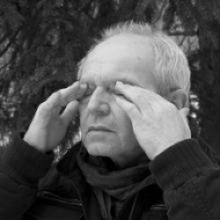
The Movement Of The Eyes And The Hands Are Not Watching Contours, But Penetration Into The Wholeness Of The Universe.
Foundational Artistic Statement
I work in the fields of visual arts and performance. My artistic concept was formed in my youth, when I undertook numerous journeys into the wilderness, driven by an inner need to approach the secrets of nature. Since the early 1960s, I have photographed, drawn, and collected natural materials—such as colours and textures—during my travels. These journeys have also resulted in numerous artist books, films, and videos.
Currently, my work focuses on immediate creative possibilities arising from relationships between historically humanised landscapes, holistic nature, and contemporary technologies. I consciously operate within an expressive field that moves between text, visual gesture, bodily movement, voice, and spatial expansion.
Current Artistic Position
Miloš Šejn (1947) has long developed an artistic practice that may be understood as an ecology of attention. It does not seek to represent the landscape or offer its aesthetic interpretation; rather, it is grounded in direct, bodily engagement with it. The fundamental gesture of this work is not a distanced gaze, but presence: walking through terrain, repeatedly returning to the same places, attentive listening to sound, and tactile contact with stone, water, soil, and air. Landscape here is neither subject nor image, but a living field of encounter, in which the artist moves as part of a broader ecological, temporal, and processual continuum.
Šejn’s work emerges from situations that precede language and naming. He works with voice, breath, trace, gesture, sound, and image as means of mediating experience below the threshold of meaning. Film, sound recording, and time-based image are not used for narration or documentation, but to register rhythms of movement, shifts of light, bodily presence, and the acoustic structure of a place. These are not symbols intended for interpretation, but events of attention—subtle transformations of perception unfolding simultaneously within body and space.
Artistic form does not arise from a predetermined concept, but gradually, through long-term and repetitive practice. The outcomes may take the form of drawings, objects, film and sound works, installations, landscape interventions, or situations that create conditions for concentrated presence. Individual media are not ends in themselves, but different ways of recording and sharing the experience of attentive being-in-the-landscape.
In this sense, Šejn’s work may be understood as a form of meditation that does not occur separately from artistic practice, but through it. The moment of visual, filmic, or performative action is not the result of prior stillness, but the very process of concentration itself—comparable to Zen calligraphy, in which the brushstroke is not an illustration of a thought, but a direct record of the state of body and mind. Gesture is not the expression of something previously formulated, but a trace of presence; image, sound, drawing, or imprint become records of the relationship between body and place at a specific moment in time.
The viewer is not guided towards interpretation, but towards participation. Šejn’s works—often realised as spatial and temporal situations—do not explain; rather, they establish conditions: for slowing down, quietening, and redirecting attention away from meaning and towards direct perception. The purpose of the work is not communication or symbolic statement, but a transformation in the quality of perception—a moment in which one finds oneself once again within the landscape, not as an observer, but as part of an unfolding process.
ArtFacts
abART
Artlist sein_CV_selected.pdf






 Academy Archives